A few years ago, “prompt engineering” was the hottest skill in tech. We thought that if we just found the perfect magic words, we could unlock the full potential of Artificial Intelligence. But as we’ve pushed AI from neat parlor tricks to real-world applications, we’ve hit a wall.
Even the most brilliant AI model will hallucinate or fail if it’s given an incomplete view of the world. The problem isn’t that the AI lacks intelligence; it’s that it lacks context.
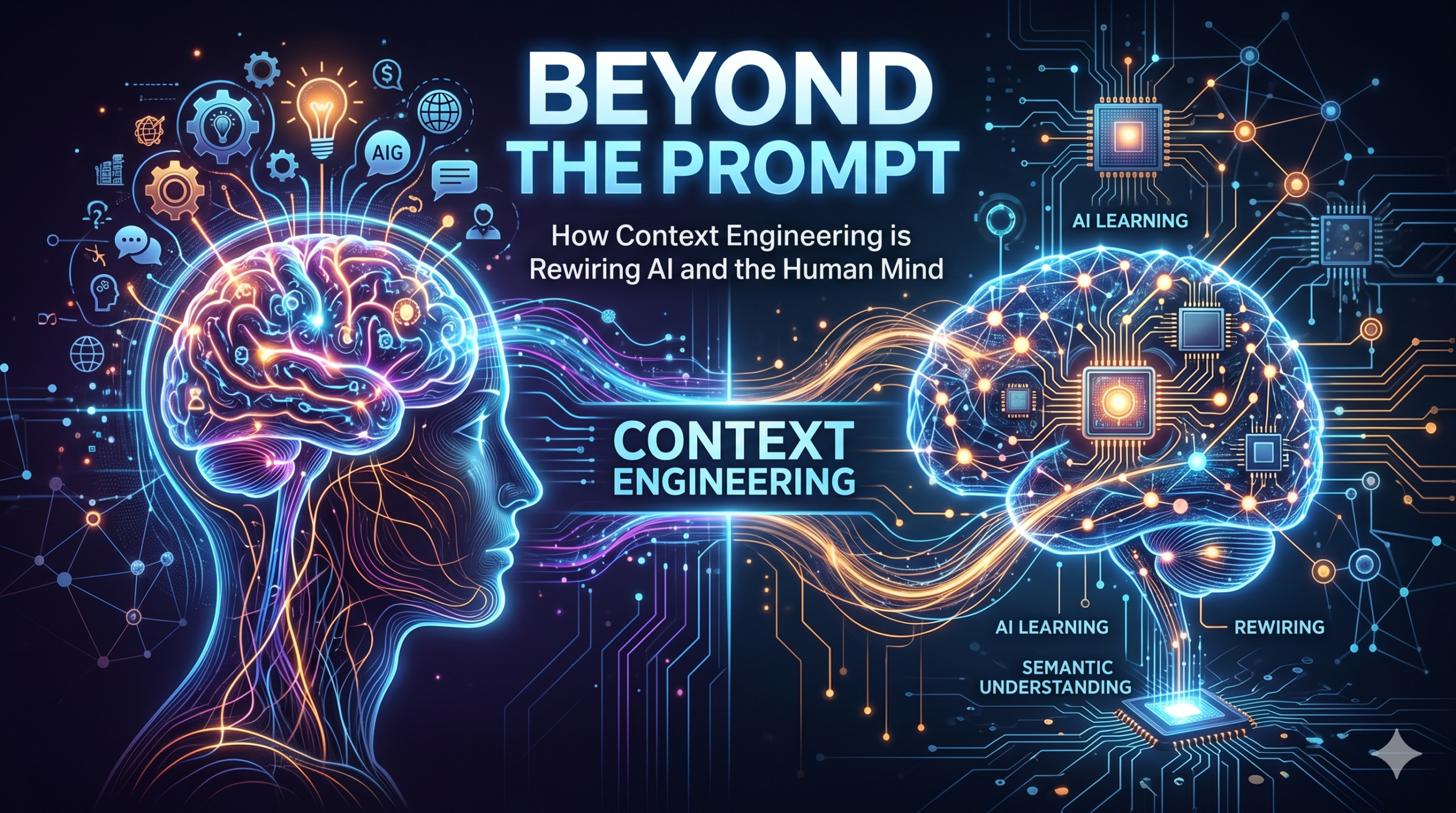
Enter Context Engineering, a groundbreaking discipline that is replacing prompt engineering as the key to success. But what’s truly fascinating is that context engineering isn’t just revolutionizing how machines think—it’s also unlocking new frontiers in human performance and psychology.
Here is a simple breakdown of what context engineering is and why it matters for both minds and machines.
What Exactly is Context Engineering?
To understand context engineering, it helps to use an analogy. Imagine a Large Language Model (LLM) as a super-smart human locked in a windowless room. No matter how smart they are, if you slip a note under the door asking, “What’s my schedule for today?”, they can’t answer it. They don’t have your calendar.
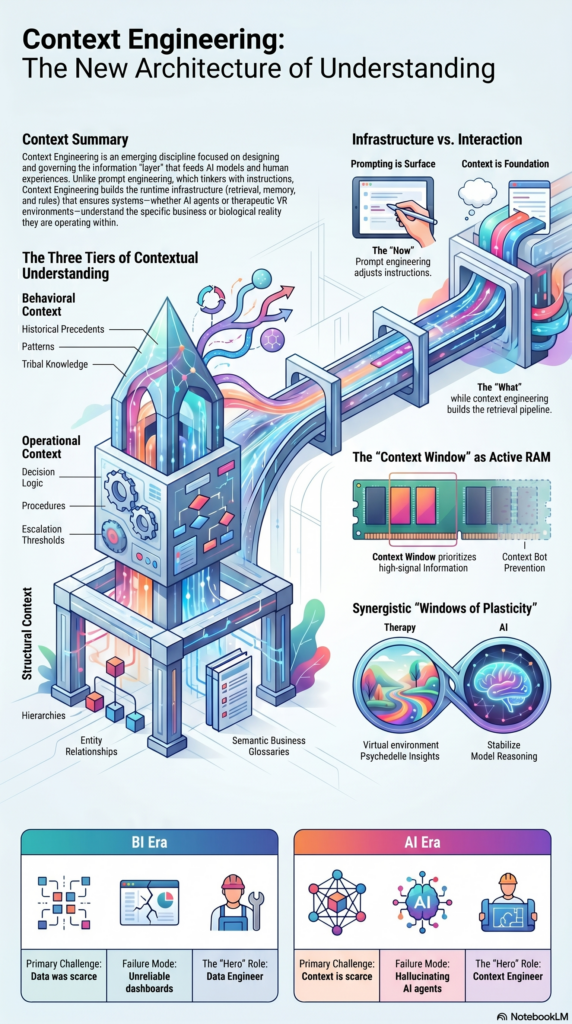
In computer terms, think of the AI model as the CPU (the processor) and the “context window” as the RAM (the short-term working memory). Context engineering is the art and science of architecting systems to feed that working memory the exact right information, in the right format, at the exact right time.
It goes far beyond just writing a clever prompt. A prompt is just a static instruction, like source code. Context engineering builds the whole environment around the AI, doing things like:
Retrieval (RAG): Dynamically searching through databases or your private documents to fetch the exact facts the AI needs before it generates an answer.
Memory Management: Giving the AI a sense of history. Instead of a goldfish that forgets you every time you talk, it uses short-term and long-term memory systems to remember your past preferences and interactions.
Equipping Tools: Giving the AI “hands” to interact with the real world, like APIs to check the live weather, book a flight, or send an email
The Shift from “Garbage In” to Reliable Intelligence:
For enterprises, context engineering solves the biggest issues with AI: hallucinations and unreliability. A model doesn’t just spontaneously know that “customer churn” means something different to your marketing team than it does to your finance team.
If an AI gives a wrong answer today, it is rarely a “model bug.” It is almost always a “context bug”. By carefully curating the data structures, business rules, and historical precedents that an AI can access, context engineers ensure that AI systems act predictably and safely.
Context Engineering for the Human Mind:
While tech companies use context engineering to build better software, neuroscientists and psychologists are using it to build better human experiences.
In the realm of human performance, context engineering involves deliberately restructuring a person’s environment to expand their perception and cognition. Our brains, much like AI, rely heavily on the context of our environment to dictate how we feel, think, and learn.
One of the most mind-bending applications of this is the emerging field of Cyberdelics—the intersection of immersive technology (like Virtual Reality) and altered states of consciousness.
Just as AI needs the right data to perform well, humans need the right environment (often called “set and setting”) to achieve personal growth and mental healing. Using context-engineered VR environments, researchers are helping people experience profound psychological shifts, including:
Awe: Simulating vast, limitless environments (like floating through the inner workings of a 3,000-year-old giant sequoia tree) to shift a person’s perspective and create a deep sense of connection.
Flow: Designing interactive virtual challenges that perfectly balance skill and difficulty, inducing a state of effortless control and deep creative focus.
Mindfulness and Biofeedback: Creating “closed-loop systems” where the virtual environment reacts in real-time to a person’s heart rate or breathing, helping to entrain deep relaxation and focus.
By altering our sensory inputs through technology, context engineering can guide humans toward “pivotal mental states”—windows of high brain plasticity where deep healing from trauma, or the acquisition of new positive traits, becomes possible.
The Takeaway:
Whether we are trying to make a chatbot stop making up fake facts, or trying to help a human being overcome anxiety, the solution is the same. Intelligence—artificial or biological—does not exist in a vacuum.
We are moving away from trying to force intelligence through brute strength or clever commands. Instead, we are becoming architects of the environment. By mastering context engineering, we are finally learning how to build the worlds that allow both machines and humans to thrive.