


Integrating AI into your software application isn’t just about adding a trendy feature or keeping up with the competition; it’s about fundamentally changing how your users interact with technology. We are moving away from the era of “static tools”—where a user clicks a button and gets a predictable, hard-coded result—and entering the era of “intelligent partners.” If you are a developer, a product manager, or a business owner, understanding how to weave intelligence into your codebase is the most significant challenge and opportunity you will face this decade.

The Human Touch in a Binary World
When we talk about AI integration, it’s easy to get lost in the “math” of it all: tokens, neural networks, and vector embeddings. But at its heart, AI integration is a deeply human endeavor. The goal is to make software feel less like a machine and more like an assistant that understands context, intent, and emotion.
Think about the last time you used an app that just “got” you. Maybe it was a music streaming service that knew exactly what you wanted to hear on a rainy Tuesday morning, or a project management tool that predicted a delay before you even saw it coming. That seamlessness is the result of thoughtful AI integration. It’s about reducing the friction between human thought and digital execution. By humanizing our applications, we aren’t replacing people; we are empowering them to do what they do best by stripping away the mundane and the repetitive.
Beyond the Hype: Defining Real Value
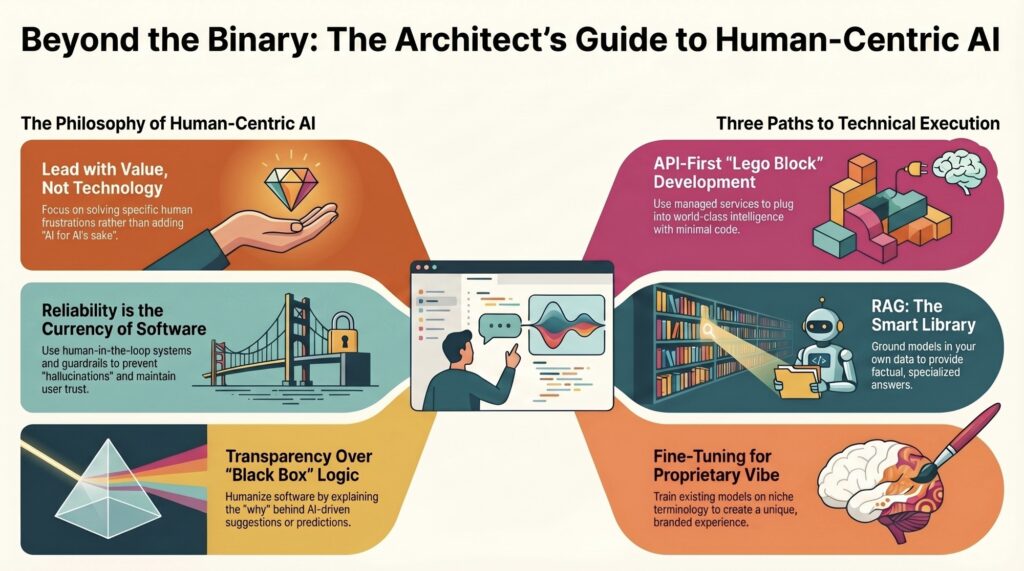
The first mistake many teams make is “AI for AI’s sake.” We’ve all seen apps that force a chatbot into a corner where a simple FAQ would have sufficed. To truly integrate AI, you must start with a human problem. Ask yourself: Where are my users getting frustrated? Where does the data become too overwhelming for a person to process?
For instance, consider a healthcare application. Integration doesn’t mean replacing a doctor. It means creating a system that can scan thousands of pages of medical history in seconds to highlight potential drug interactions that a tired human might miss. It’s about providing a safety net. In a creative suite, AI integration might look like “generative fill,” where the software handles the tedious task of extending a background so the artist can focus on the subject. When you lead with value rather than the technology itself, the integration feels natural rather than forced.
The Architect’s Dilemma: How to Build
Once you’ve identified the “why,” you have to tackle the “how.” For most teams, building a custom neural network from scratch is like trying to build a car by first inventing the wheel and refining steel. It’s unnecessary and prohibitively expensive. Instead, modern integration usually follows three paths:
The first is the “API-first” approach. Using managed services—like those provided by Abacus.AI—allows you to plug into world-class intelligence with just a few lines of code. This is the “Lego block” method of development. You get the power of a multi-billion dollar model, and you only pay for what you use. It’s the fastest way to get to market.
The second path is Retrieval-Augmented Generation (RAG). This is arguably the most exciting development for software developers. RAG allows you to take a “smart” model and give it a “library” of your own data. If you’re building a customer support tool for a specialized hardware company, you don’t need the AI to know everything about 18th-century poetry; you need it to know your specific product manuals. RAG lets the AI look up your data in real-time to provide answers that are both intelligent and grounded in fact.
The third path is fine-tuning. This is for when the “vibe” or the specific “language” of your app needs to be unique. Fine-tuning is about teaching an existing model a specific style or a very niche terminology set. It’s more resource-intensive, but it results in a product that feels truly proprietary.
Navigating the Ethics and the “Ick” Factor
We can’t discuss AI integration without talking about trust. Users are rightfully concerned about where their data goes. As a developer, your integration is only as good as your privacy policy. “Black box” AI—where the user has no idea why a decision was made—creates a sense of unease. To humanize the integration, you must prioritize transparency. If an AI suggests a change or makes a prediction, tell the user why.
Moreover, we have to tackle “hallucinations.” AI can be a very confident liar. Integrating AI into software means building guardrails. This includes “human-in-the-loop” systems where the AI does the heavy lifting, but a person provides the final stamp of approval. Reliability is the currency of software; don’t let a flashy AI feature bankrupt your user’s trust.
The Future is Collaborative
As we look forward, the distinction between “software” and “AI” will likely disappear. We don’t talk about “electrical appliances” anymore; we just call them appliances because the electricity is assumed. In five years, we won’t talk about “AI-powered apps.” We will just expect our software to be context-aware, predictive, and helpful.
Integrating AI is an iterative process. It’s about starting small—perhaps with a smarter search bar or an automated tagging system—and building toward a more complex, autonomous ecosystem. The most successful integrations will be the ones that stay invisible, working quietly in the background to make the user feel like a superhero.
The journey of integration is a marathon, not a sprint. It requires a blend of technical expertise, ethical consideration, and, most importantly, empathy for the end user. By focusing on how we can make life easier and better for the people using our tools, we ensure that the rise of AI in software remains a positive, human-centric evolution. Start building today, but keep the human at the center of your code.