


It feels like every week there’s a new “game-changing” AI tool hitting the market. For those of us in the DevOps world or just anyone trying to stay productive, the noise can be deafening. But behind the hype, a very clear ecosystem of tools has emerged.
We aren’t just talking about chatbots anymore. We are looking at a suite of specialized assistants that are fundamentally changing how we process information, write code, and create art. Here is a breakdown of what is available right now and where we are headed.
The Toolkit: Current Types of AI:
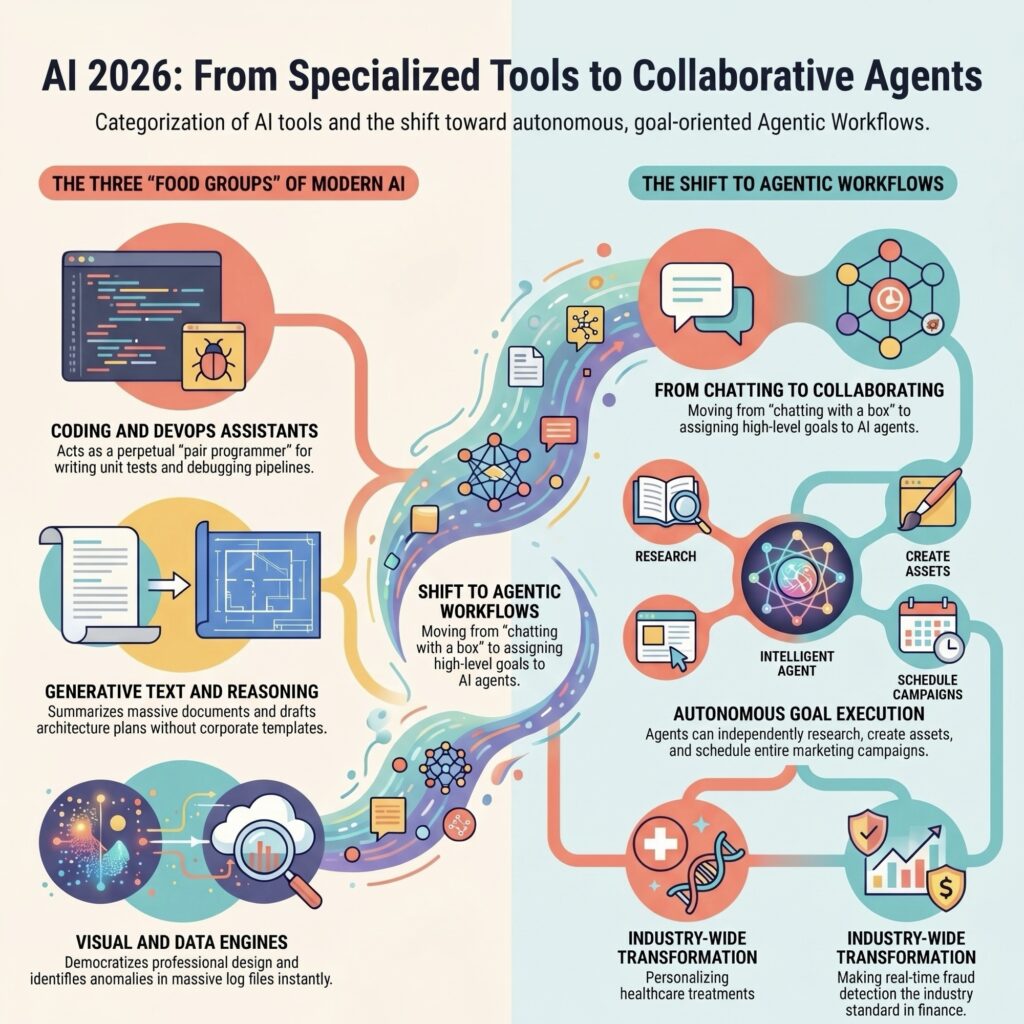
The current market is generally split into four major “food groups” of AI:
- Generative Text and Reasoning: These are the heavy hitters like the one I’m using to help write this. They aren’t just for chatting; they are excellent for summarizing massive documents, brainstorming architecture, and drafting emails that don’t sound like they came from a corporate template.
- Coding and DevOps Assistants: For the DevOpsPal audience, this is the core. We have tools that can now write unit tests, suggest infrastructure-as-code (IaC) snippets, and even debug complex pipeline errors in real-time. They act as a perpetual “pair programmer.”
- Visual and Creative Engines: From generating 1:1 social media carousels to creating high-fidelity UI mockups from a simple sketch, these tools have democratized design. You no longer need a degree in Photoshop to create professional-grade assets.
- Specialized Data Analyzers: These tools can ingest a massive CSV or log file and identify anomalies or trends in seconds—something that would take a human analyst hours of spreadsheet gymnastics.

Why This Matters for Everyone
You don’t need to be a software engineer to benefit from this shift. For the “everyday” user, AI has become a cognitive lubricant. It removes the friction of the “blank page” problem. Whether you’re a student organizing research, a small business owner automating customer replies, or a hobbyist learning a new language, these tools act as an on-demand tutor and administrative assistant.
Industries Leading the Charge
While AI is horizontal, some industries are seeing a vertical explosion in efficiency:
Software Development & DevOps: We are seeing “vibe coding” allow developers to focus on high-level logic while AI handles the syntax.
Healthcare: AI is being used to cross-reference patient data with the latest medical research to suggest personalized treatment plans.
Marketing and Content Creation: Teams are producing personalized content at a scale that was previously impossible, tailoring messages to micro-segments of their audience.
Finance: Real-time fraud detection and automated “robo-advisors” have moved from being experimental to being the industry standard.
What’s Next? The Future of Our Workflow
We are moving away from “chatting with a box” and toward Agentic Workflows.
In the near future, you won’t just ask an AI to “write a post.” You’ll give it a goal: “Launch a marketing campaign for DevOpsPal’s new guide.” The AI agent will then independently research the topic, generate the images, schedule the social media posts, and report back on the engagement metrics. We are moving from AI as a tool to AI as a collaborator.